I bought a pair of carbon-plated running shoes, the Saucony Endorphin Elite 2. I’ve written about carbon-plate technology on this blog but only from an observation and research perspective, not from direct use.
For several years, I resisted the urge to purchase shoes with this technology. It seemed like a luxury-level expense for my ego, as opposed to my being on the cusp of an all-time personal best and seeing if the potential extra return from the plates could get me there. However, the technology is prevalent and being used by many runners. Not only might it possibly help me achieve a faster time, I also wanted to see what the shoes felt like and what the differences were between them and traditional trainers and flats.
I considered a few different options among carbon-plated shoes but there were two main reasons I chose Saucony. I’m a heel-striker and the shape of the Endorphin Elite seemed best-suited to that. Also, I’ve liked Saucony in the past.
When I put them on, they were unlike anything I’ve ever worn. For starters, the weight is absurdly light. Each shoe is 7.43 ounces. My current trainers, the Asics GT-2000, weigh 9.65 ounces. Two-plus ounces doesn’t sound like a lot, but the difference can be felt, and it is a 23% weight difference. Those Asics are relatively light and my prior trainers, the Brooks Adrenaline, weigh in at 10.26 ounces. The weight of the Saucony shoes is particularly remarkable since they can be used for longer races.
They also, to me, felt nearly wobbly as the flex/bounce factor from the carbon plates is intense. When I took them on a test run, initially I wasn’t sure I could handle tight turns without wiping out. However, a mile or so into the run, I got more comfortable with them and for me, they were fine on all turns.
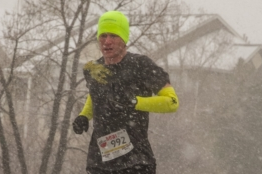
I bought the shoes with the hope I could use them for the Bolder Boulder, the famous Memorial Day 10K. With the amount of bounce, I was 50-50 on wearing them, primarily concerned about creating some strange injury, but since everything had gone fine in my 30-minute test run, I decided to roll the dice and use them.
As I’ve noted in the past, carbon plates are supposed to return a higher level of your energy, thus making you faster and, in theory, keeping you a little fresher.
My goal time for Bolder Boulder was 42:50. This would requalify me for the AB starting wave for the 2026 race. (Technically the qualifying mark is 43:00 but they do sometimes change these time standards so I wanted some cushion.) Based on my training, I knew that it would be close on whether I achieved this time. If the shoes reduced my time by 1% to 4%, the amount that some shoes say they can cut, that would help considerably.
Generally, my legs felt good during the race. However, I accumulated fatigue during the race and between 5K to 6K, I was questioning whether I would make the mark as I was about 15 seconds off. Bolder Boulder is a net uphill race but much of the climbing is in the first four miles. There is then significant descent from around 7K to almost the 9K mark. I was counting on that stretch to make up some time.
By 7K, my time was in decent shape and I was able to push through the final 3K to come in at 42:24.
I think it’s clear that the shoes helped. Not only did I run at the faster end of what I reasonably expected, my legs felt better in the later stages of the race than they have in a while. To put it a different way, I often can push/kick towards the end of a race but in these, I felt I was still pushing with intensity.
To be clear, I still very much felt the effects of the race when I was done and the next day-they don’t help with recovery-but even though Bolder Boulder was one experiment, I’d say the technology works.
Running anecdotes, running food reviews, some race coverage, and more