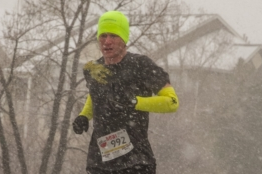
Three of us on the Dry Creek Striders recently had experiences that were unprecedented for each of us. (I may call it four–I can’t recall the last time I struggled with coming up with a title for a post. Even armed with a thesaurus, I came up dry. I digress…)
It’s probably clear from the team statistics and prior posts that Collin often wins races that he enters. He holds impressive win streaks from previous years but between 2025 and 2026, he put together ten straight wins. The races varied in size and location around the metro area. His previous record was eight and when he tied that, his primary focus was getting the ninth to set a new record. Getting to ten was an added bonus.
In June, DJ did an unusual double in Florida. He began the day by running a 5K in 16:58 on a bizarre course that used loops in a mall parking lot. The second race was a rum-runner mile. Similar to the beer mile, where contestants chug a 12-ounce beer every quarter mile within a short transition zone, the runners had to down a 4-ounce rum punch every quarter mile, or every one-third of a mile due to odd course measurements that made it 1.33 miles.
In June, I ran a double at an All-Comers Track Meet, including my first-ever all-out 400M. I had modest expectations which was good. I went out way too fast but held on for an okay finish at the end. The immediate aftermath (track-hack cough) was rougher than I had expected. The upside was that when I ran the 3000M an hour later, instead of the opening lap feeling rushed and hectic, it felt okay compared to the all-out pace of the 400M.
Rest rules…
Early in my running years, I was told that while it’s important to get sleep the night before a race, it’s equally important to do so the night before the night before a race. Pre-race sleep can be challenging due to nerves. By banking some a little earlier, there’s a better foundation for race day. (I try to make sure I’m rested several days before a race but that’s a slight tangent from this post.)
It always seemed like good common sense and I never questioned it. It’s possible that I’ve had a race or two where I didn’t follow this advice but one consequence of not being rested didn’t hit home until this weekend during a local 5K.
I always assumed that getting good rest related more to being physically prepared for the race and I still think that’s true. But, this consequence didn’t deal solely with being physically tired. We were on a camping trip a few days before the 5K and I didn’t get the best rest in the world. The 5K was on a Saturday and specifically, it was Wednesday and Thursday nights where I didn’t sleep well. On Friday, I basically got a solid night’s sleep but during the drive to the event on Saturday, I couldn’t recall a time when I’d felt more exhausted in the couple of hours before the race started. I actually sipped some extra coffee on the way in, which was way outside of my normal pre-race plan. Given how much I was yawning, I figured it was worth the risk.
Once the race started, I set out and I thought I was running like normal. At just over a mile in, I realized that while I was running “hard,” I wasn’t pushing myself at the level I normally would during the race. The explanation was simple. My brain was tired and I wasn’t focusing at 100%. I would have thought the motivation to run hard would automatically kick in but it definitely had not. Fortunately, this was early enough in the race that I was able to dig in a little harder and make up some of that time. And, this was a blip in the record and a reminder to stick to good advice. It’s not like I’ve ignored pre-race rest rules for years and am now kicking myself.
Sometimes, pre-race circumstances are outside of our control and we may not be able to arrange rest preparation the way we want. To the extent that I can, however, I will continue to plan for good rest going forward. When I didn’t have it, it showed.
Sub-two numbers…
Sabastian Sawe rocked the running world on Sunday at the London Marathon by becoming the first person to run an officially ratified marathon time of under two hours. It wasn’t close as he ran 1:59:30. The second person to officially break two hours in the marathon, Yomif Kejelcha, was only 11 seconds behind him in 1:59:41. Both of these men easily broke the world record that stood before the race of 2:00:35. The third-place person at London, Jacob Kiplimo, also broke that world record by cruising through at 2:00:28. Plenty of articles will detail how it all panned out. Here are a few fun numbers and facts from Sunday.
Sawe ran mile 24 in four minutes, twelve seconds, or 4:12. The overall per-mile pace for his race was 4:33.66 so 21 seconds faster is impressive in its own right. To add more context, 4:12 is the per-mile pace for the 10000M world record, an event with 20 fewer miles. A 4:12 mile within a marathon, especially that late in the race, is absurd.
4:33.66 should sound speedy to most people. For additional perspective, that’s 68.03 seconds/lap on a 400 meter track, or 17.008 seconds per 100M.
Sawe’s achievement is impressive. Kejelcha’s achievement is no more than a hair width behind him in terms of accomplishment as it was his first marathon ever. He easily secured the record for fastest debut marathon.
Sawe ran the first half of the marathon in 60:29 and the second half in 59:01. The US men’s record for the half marathon in currently 59:17 so Sawe broke that in the second half of a full marathon.
One of my Dry Creek Strider teammates, Collin Knaub, pointed out that it probably helped Sawe and Kejelcha to get under two hours by being able to push each other at the end. I agree with that. General conversation about who would first officially go under two hours revolved around which single runner would make that breakthrough. However, pushing ourselves is often easier when we have people around us in a race and that would be no different in these circumstances. In other words, it is incredible that two people broke this legendary barrier on the same day but it also makes sense because they were able to push/run with each other.
It’s fun to look at the accomplishment today and watch the video. Of course, the Berlin Marathon has seen the most world records in recent years and that occurs in the fall. With the two-hour barrier now broken, what will we see from the athletes and shoe companies as that legendary race approaches in several months…
Source used:
https://www.letsrun.com/
When reality doesn’t meet expectations…
There are four stretches of dirt trail, each ranging from .1 to .5 miles, along my standard running routes where my pace as it relates to effort doesn’t make sense in the context of the terrain. It’s common knowledge that we tend to run faster on most downhills whereas going uphill requires more effort.
Two of these stretches, roughly .1 mile each, have a clear elevation change. Both are gradual but they’re fairly easy to see. However, when going uphill along them, I never have any issue maintaining or increasing my pace.
There’s a .5 mile stretch near my house and when I’m on my way back on a run, it occurs between 1.5 miles and 1 mile to go. There is clearly elevation change of the uphill variety on this stretch and I can definitely feel more strain. However, my pace always gets faster along it. More absurdly, it’s not like this is a case of getting closer to home because I find the final mile that follows it to be challenging and my results within it are all over the place. Note, this oddity of being unexpectedly faster is fine, it’s just odd.
The final and most perplexing of these four is a .25 mile stretch just west of me. It looks pancake flat. According to my watch, there is elevation gain but it’s not significant. However, every time I run it, my pace gets clobbered and I struggle, even if I’m pushing hard to compensate. Running the opposite direction on it, I might still feel terrible and yet my pace is noticably faster. At least there’s benefit in the opposite direction. I would say this stretch is in my head but a couple of friends of mine have experienced the same phenomenon.
I did a post some time back about the illogical effect of places on a couple of athletes’ and team’s performances. I suppose this is in the same vein of places where reality doesn’t meet expectations.
Warm-ups…
I’ve never questioned the value of warm-ups before a race and I’ve always done them. However, it’s been during recent threshold workouts that I’ve had the benefit of warm-ups reinforced. Threshold is where I’m not going quite at race pace but I am going about as hard as I can at that distance for a training run. By the end of it, I should be spent. The goal is to mimic race conditions. In short, it’s a tough effort with high exertion.
When I was younger and I went for a threshold run, I simply threw on my shoes, stepped out the door, and took the tachometer up to redline.
That doesn’t work so well any more. I often feel much worse early in the run than I did in prior years and my pace might drop off. What I also noticed is that in the first mile or two, if I came to an involuntary stop (street crossing) or voluntary stop (this sucks and I feel terrible), when I picked it back up again, I felt infinitely better.
So what does that mean? I’m adding a short warm-up for my threshold runs. For races, I typically run an easy 10-15 minutes before anything up to the 10K distance. (Anything longer, like a 10-miler, and the warm-up time is shorter. My top speed during the race isn’t as fast so I don’t need to be as loose, and I don’t want to lose too much in the warmup.)
I’m not doing a full race-level warmup for the threshold runs, just a quarter or half-mile jog. But, it should be enough to wake my legs and lungs up and help me jump into a redline-level effort without feeling quite as awful. In doing so, it could help the workout more accurately mimic the race, as in allowing me to maintain the planned pace better and reduce the odds of a voluntary stop.
Wrenches…
One area that all runners have to deal with in their training and racing is unexpected changes or circumstances. If my warm-up routine gets changed because the parking logistics of the race are more challenging than I planned on, my first reaction is not to roll with it, it’s, “Crap. That messes up my plan.”
However, in a few cases where my pre-race plans have not gone exactly how I laid them out, things have still turned out well, or even better than I expected. Still, it takes some mental adjustment.
Since it’s impossible to control every circumstance out there (illness during training, bad traffic going to the race, etc.) it’s important to be prepared for the unexpected. How the heck can we do that? I don’t have a perfect answer but I have an idea I’m going to try out over the next few months.
For my training for the winter/early spring, I have a set number of miles I want to log per week and certain types of workouts I want to include. However, one day per week I’m doing a “Wild Card” and on that day, I’m going to blindly draw a workout from three or four different ones. All of them will be within the same type of difficulty. It might be five miles at an average pace, or a two-mile threshold, or a speed workout that has one-third to one-half the number of reps I would do for a full one. While I will have designed and picked the workouts that I’m choosing from, by not knowing exactly what I’ll do until the day of the workout, I think it will help acclimate my brain and body to unexpected race day or training surprises. A full evaluation to follow sometime later…
Super Start…
The Dry Creek Striders traditionally do a Super Bowl Time Trial on Super Bowl Sunday and this year, we continued that. We decided on a two-mile run at the Mead High School track for early this morning. Three of us were able to make it and we had varying expectations. Collin was relatively tapered and looking for a solid predictor of his time expectations for the season. DJ was not as tapered but had been incorporating speed work into his training. I’ve just started my formal training and was coming in after a tough week of training mileage.
Before diving into the results of that and moving solidly into 2026, there are a few notable team results from 2025 to highlight. All of us tried carbon-plated shoes for the first time and our times were very good with them. While that’s a small sample size, so far they lived up to their reputation. I tried a new event, the 3000M, on a track. DJ ensured that we kept our interstate racing alive as he competed in two races in Florida. Collin earned the team’s 50th individual win this past fall. And, we notched our second-ever podium sweep in March at the Lucky Brew 5K in Windsor.
Onto 2026. For the Super Bowl time trial, we met at 8:00 with an expected start time of 8:30, factoring in a warm-up run, stretching, etc. The order of finish really isn’t doubt. The big questions are what our times look like against our expectations. Our reactions to our results ranged from “meh” to enthused. I came in on weary legs and my time reflected that, so it wasn’t a big surprise. DJ finished within the realm of his expectations. Collin came in faster than his predicted time.
As an added bonus, since this year is Super Bowl LX, we did a 60M dash after the two-mile. None of us are or ever have been sprinters and the results pretty much reflected what you would expect from three distance runners who just finished a two-mile, have no starting blocks, and possess zero sprinting experience. But, we each earned a personal best (it had to be since we’d never done one before) and it was fun.
We’re still sorting out the beginning of the 2026 race schedule and will keep that updated on our team page.
Into the holiday season…
We’re now fully into holiday season which often means busier schedules, more gatherings, and possible travels. This also can mean that it’s more challenging to keep up training miles. I’ve posted several times in the past on different ways to adapt to the season in ways that can allow you to maintain some semblance of fitness without overly taxing your schedule. Instead of rewriting them, I’ve linked to them below. The first is a general overview of ways to adjust schedules and expectations; the second is a bit on making yourself visible in dark conditions; the third is a brief tip on how to adjust to brutally cold temperatures.
I’ll reinforce one point from the third post, which is to carry an extra piece of headgear on longer runs in cold weather. The other day, I almost didn’t. It was in the low twenties and I was planning on eight miles at a moderately fast clip. I figured that if I could finish in an hour or so and if I was moving fast, I wouldn’t need it. Thank goodness I did carry an extra headwrap because when I went through mile six and the breeze picked up, my soaked-through hat was doing far more harm than good and the fresh, dry headwrap felt wonderful.
https://untamedrunner.com/index.php/2024/11/19/holiday-training/
https://untamedrunner.com/index.php/2021/12/11/holiday-schedules/
https://untamedrunner.com/index.php/2025/03/05/winter-running-or-summer-in-reverse/
New and old territory part two…

This isn’t a direct sequel to my last post, it simply happens that I had additional new experiences since that time. On Sunday, I raced a 1600M at a new track meet that was announced recently by the Boulder Road Runners. Though I hadn’t planned on racing until early September, the meet occurred near my house and was inexpensive by race standards. My expectations were low since this event wasn’t on my radar, but I couldn’t reconcile turning down a meet with those two factors.
How was this new territory? The race was at 5:00 on a Sunday evening, which is unusual. I’m 99.9% sure I’d never raced on a Sunday evening. There are plenty of races on Sunday mornings where I’ve competed and I’ve done evening races, just not in combination. It wasn’t a radically new experience, but it was a “first” for my running portfolio.
The other new experience was the temperature at the start of the race and an effect from it. It was in the low 90s with the sun beating down. Readers of my blog are well-aware that I enjoy running in the heat and this temperature was still far-off of my personal record of running in 105.8 degrees. It was basically tied for the hottest race I’d competed in, which was 91 degrees during a nighttime 5K in Phoenix, AZ. The key word there is nighttime.
500 meters into this race, my throat went to parched dry and raspy. I was stunned. I’d experienced this in hot weather running before, but never until I was much further into the run. This didn’t happen at all in Phoenix. I came up some possibilities for why it occurred.
Most of us are well-aware of the difference between being in the sun versus shade on a hot day. There were patchy clouds around race time but for the duration of the 1600, it was all sun with nothing blocking it. The bigger factor, I think, was the intensity of the race. On a long run in hot weather, I may be going at a per-mile pace of anywhere from 8-minute-something to very high 6-minute-something. On Sunday, my final time was 5:52. I was pushing my body at a higher level, trying to suck in more oxygen than I normally would, and that likely caused some of the drying out. It’s true that I wasn’t going much slower in Phoenix (roughly 6:10 mile pace) but it is slower and I go back to the sun intensity. Also, on a long run in hot weather I’ll carry fluids, which obviously staves off the dry throat factor.
The photo at the top of the blog is post-race from Sunday and I’m holding up my third-place prize: a microwavable “Beast Mode Breakfast” meal. It ranks among the more unusual prizes I’ve taken home. It was much easier to prepare than the frozen turkey I won from one race, and just slightly more time-consuming to prepare than the bundt cake I won at a different one.
New and old territory…
Over the past few years, I’ve run at several local “all-comers” track meets in the area, mainly at those hosted by the Boulder Road Runners running group. The meets are exceptionally well-organized and fun. They offer athletes of all ages and talent levels to compete in a variety of events, ranging from the 100M to the 5000M for running, and field events including jumps and the javelin.
The event offerings change among the different meets so a couple of them may have the mile run (1609M) while others feature the “metric mile” or the 1500M. One this summer even offered the 3000M.
The 1500M (3.75 laps on a 400M track) and 3000M (7.5 laps on a 400M track) are common events at professional track meets. They’re less common at US events. I’d done the 1500M at one of the meets in the summer of 2024 but wanted to give it another go as I realized my pacing strategy needed a major tweak. I had never competed in a 3000M and opted into for that, too. That was the new territory.
The old territory came with my doing both events in the same evening, separated by roughly 90 minutes. However, I hadn’t done a “double” in competition since my high school track days where that’s common, and I was very rusty on how to handle that. I didn’t want to coast in the 1500M, the first event, and only preserve my legs for the 3000M, and I also didn’t want to get to that race with my legs and energy sapped from the first one. How to plot my pace to maximize my times in both?
I took my most recent 5000M time, adjusted the pace down a bit for the 4500M total I would actually be racing plus the 90-minute break, and came up with what I felt were reasonable times. Suspense saver–I ran a few seconds faster than both of my predictions so I think I had the math right. After the 1500M, I still felt fairly good. Following the 3000M, I was toast–nothing left.
The second challenge was what to do between the races. I settled on running a slow half-mile right after the 1500M, followed by resting for a bit, then doing another half-mile-plus re-warm-up for the 3000M. Given how I felt and how the races played out, that worked for me.
Since I’d never done a 3000M, my strategy was to go out at the pace I was 99% sure I could hold for the first 3.5 laps, then just go with however I was feeling. I’ve noticed in a two-mile (3218M, or roughly eight laps) that my brain is stuck on 5000M mode until I get to lap five, when I realize I’m over half-way done, which creates a pleasant mental boost. In the 3000M, on lap three I was having serious doubts about my pace. I think this was partly due to my doubling up on events and then similar to the two-mile, as I entered the final four laps, my brain shifted.
The tweak for the 1500M? The first time I ran it, I calculated my time for the first 300M, followed by my 400M splits after that. My rationale was simple. The 1500M starts 100M around the track from the eventual finish line and I figured it would be easier to use that as my main marker. It’s important to note that many track athletes think in terms of 400M splits for events that are multiple laps.
The reality was that when I started with a 300M split, my mid-race math got wobbly. I don’t know that it greatly impacted my time but when you’re making adjustments in that short of a race, you don’t want to be too far off. This time, I switched to thinking in terms of even 400M splits for my first three laps, using the start line as my marker, and then going all-out for the final 300M. That worked much better.
I don’t know how often I’ll seek out more doubles as they present a challenge. Besides the physical part, when you can’t really go 100% for the first event and then you know you’re already a little depleted for the second, there is the question in the back of my mind, “How much faster could I have gone?” On the other hand, it’s fun to have two possibilities of success, or a situation where you can have a great first or second event, helping to erase any disappointment from another one.